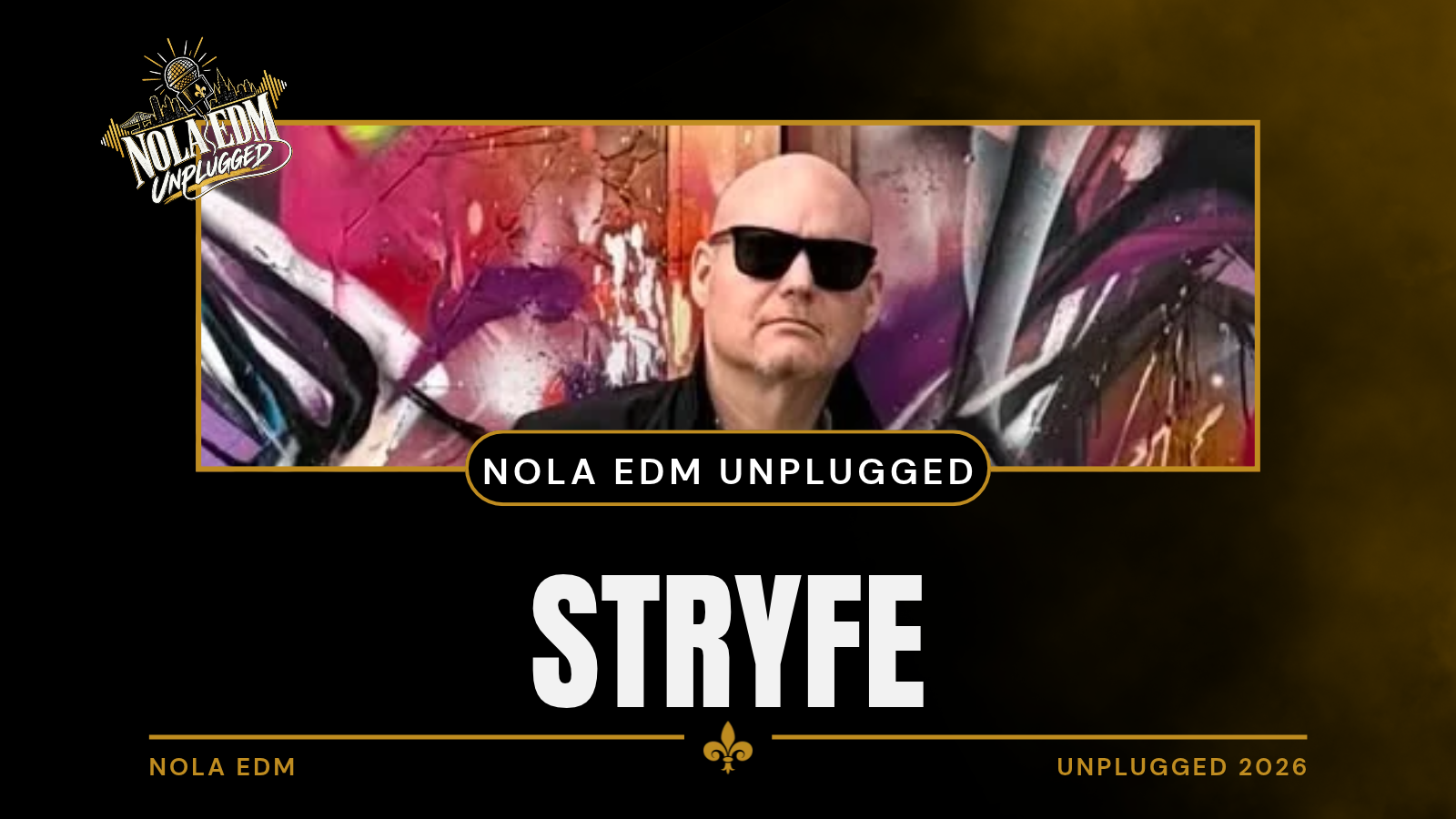
A State Palace resident and co-founder of the Freebass Society, Stryfe looks back on the rise of New Orleans rave culture, the community that filled the Palace, and why understanding that history could help shape what comes next.
Before the State Palace Theater became an epicenter of Southern rave culture, Stryfe was already helping build the community that would eventually fill it.
Stryfe, also known as Dan Milstein, arrived in New Orleans in 1993 as a freshman at Tulane after getting an early taste of New York nightlife and house music. He began as a promoter before becoming a DJ, connecting with other early figures in the scene, working at Cyberpig on Decatur Street, co-founding Moon Patrol, and eventually forming the Freebass Society with Disco Donnie.
As the State Palace parties grew, so did Stryfe’s place behind the decks. His harder sound made him a natural closer, with sets stretching into the early morning as crowds stayed for the energy that became his signature. He remembers a venue filled with househeads, drum and bass fans, breakdancers, drag queens, and ravers moving between rooms and genres under one roof.
More than three decades later, Stryfe sees both enormous potential and a missing connection in New Orleans electronic music. The city has more DJs, crews, and events, but he believes greater collaboration could reconnect those individual communities and create something larger.
For this episode of NOLA EDM Unplugged, we caught up with Stryfe to look back on his roots in New Orleans’ early rave scene, the rise of the State Palace Theater, his years behind the decks as a resident and closing DJ, the community that grew around the Palace, and why preserving that history could help reconnect the city’s electronic music scene today.
Stryfe traces his place in New Orleans electronic music back to 1993. He arrived in the city as a Tulane freshman, started promoting before he started DJing, and became connected to a group of DJs and promoters helping push the city’s emerging rave scene forward.
That path eventually led through Moon Patrol and into the Freebass Society, which Stryfe co-founded with Disco Donnie. As regular State Palace parties took shape, attendance grew from roughly a thousand people into the thousands, culminating in an event at UNO Lakefront Arena that Stryfe remembers drawing around 8,000 people.
Inside the State Palace itself, nearly every available part of the old theater became part of the experience. There were DJs in the foyer, a jungle room, a chill room, a record store, music on the roof, and a main room capable of holding thousands.
For Stryfe, the Palace also created his identity as a resident DJ. His harder, faster sound made more sense at the end of the night than before visiting headliners, eventually establishing him as the DJ who closed the parties around 5 or 6 in the morning.
But what he remembers most clearly is the crowd.
“You felt like you were a part of something and I think that’s what people really gravitated towards.”
The Palace wasn’t built around one electronic genre or one audience. Stryfe remembers househeads, drum and bass fans, breakdancers, drag queens, and other communities sharing the same event because the scale of the venue allowed promoters to build something for all of them.
Looking at New Orleans today, Stryfe sees a strange contradiction. There are more DJs and crews, and that diversity creates enormous potential. But those communities are often spread across smaller events instead of meeting inside the same larger experience.
His solution is collaboration.
Stryfe imagines promoters intentionally bringing DJs from different crews together, much like State Palace lineups once connected genres, communities, and even neighboring scenes across Mississippi, Alabama, Lafayette, and Texas.
That desire to reconnect the present with the past runs deeper than nostalgia.
Stryfe describes New Orleans electronic music as a “scene interrupted.” In his telling, law enforcement pressure, the DEA, the RAVE Act era, and eventually Hurricane Katrina disrupted a scene that had grown into something much larger. Katrina also scattered people who had helped build it, including STRYFE himself.
He now lives in Chicago, where he sees younger generations learning the lineage of their city’s house music culture. He wants New Orleans ravers to have that same relationship with their own history.
Stryfe is also working with Dave Jinx to research the roots of the New Orleans rave scene before 1993, reaching out to earlier figures to preserve their stories.
For him, knowing that history isn’t only about remembering what New Orleans once had. It could help today’s scene understand what made that community work in the first place.
“I would love to see New Orleans have a massive scene.”
NOLA EDM Unplugged documents the artists, DJs, promoters, organizers, festivals, venues, and people shaping New Orleans and Gulf South electronic music, past and present.
Interview: NOLA EDM
Guest: Dan Stryfe
Audio: NOLA EDM
Series: NOLA EDM Unplugged
Location: Louisiana
Published: October 28, 2026
New Orleans, LA
NEWSLETTER