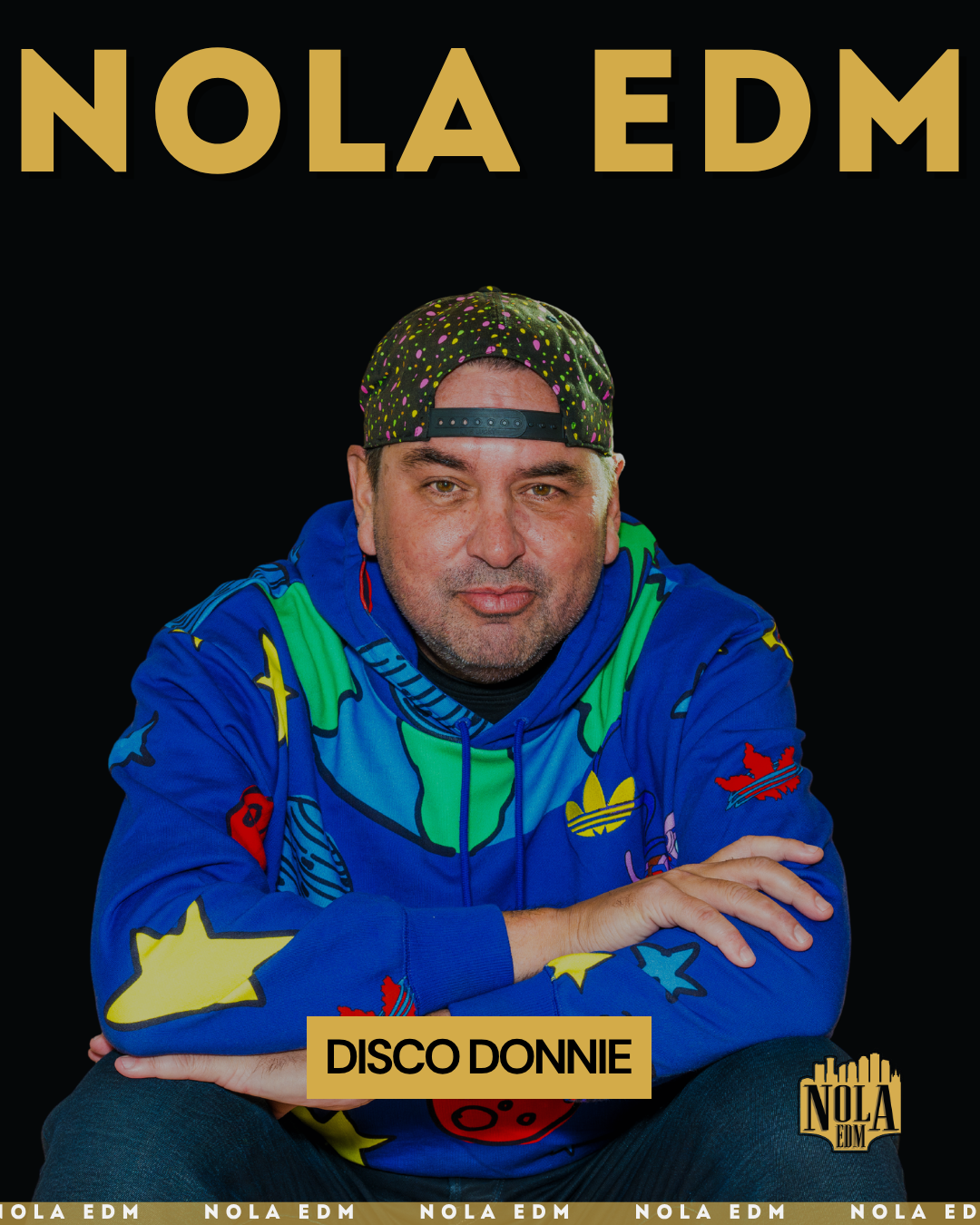
⚜️ Inside Disco Donnie’s Role in Building New Orleans Rave Culture and What He Sees for Its Future ⚜️
Disco Donnie on New Orleans Rave History, State Palace, and What Comes Next
Long before electronic music became a mainstream festival industry, Disco Donnie was helping build a rave scene in New Orleans one flyer, one party, and one conversation at a time.
We caught up with Disco Donnie (@realdiscodonnie) to revisit the beginnings of New Orleans rave culture, the rise of State Palace, Freakfest and Mardi Gras, the collapse of that early era, the city’s changing electronic audience, and what it could take to build the next chapter.
NOLA EDM: Take us back to the beginning. How did you first find New Orleans’ electronic music scene, and what made you want to become part of it?
DISCO DONNIE: I had gone to some parties while I was going to school at LSU in Baton Rouge. It was more industrial-type raves, maybe a precursor to what was happening in New Orleans. When I got out of school and moved back to New Orleans, I was working at my mom’s accounting firm and waiting tables on weekends. Some of the other waiters invited me to a party, and I think the first event I went to was at Rubyfruit Jungle on Frenchmen Street.
It was such a diverse crowd. You had drag queens, B-boys, white people, Black people, everybody there together. I hadn’t been exposed to something like that before, where all these different subsections of people were hanging out in the same room.
It was intriguing to me that this whole culture was going on around electronic music. It wasn’t just a concert. It was an event centered around electronic music and a scene. But it was poorly attended. Everybody was super nice and accommodating, and I remember thinking, “This is really great, but I didn’t know about it. If I don’t know about it, how are other people going to find out about it?” So I started taking flyers from the tables.
NOLA EDM: How did taking those first flyers turn into you becoming one of the biggest promoters in New Orleans?
DISCO DONNIE: I started promoting on my own, just trying to get more people there. People started seeing me promote, and then they started asking me to promote for them. At first, I was just doing it for fun. I already had two jobs and a career. Eventually people started offering me money, and at some point I said, “Yeah, I’ll do it, but I want 50 percent of the door.” That’s kind of when I became a promoter.
There were different promoters around New Orleans at the time, but a lot of them eventually quit doing shows or moved to other cities. I probably went to my first party around 1994, did my first party about six months later, and roughly 12 months after that I was the biggest promoter in New Orleans. I was working hard, but it was also just the way everything broke.
NOLA EDM: Before social media and modern online promotion, what did it actually take to build an electronic music audience in New Orleans?
DISCO DONNIE: We were going out every single night under the guise that I was promoting. Wherever people were, I was out there promoting. I’d wake up at one or two in the afternoon, hit all the stores in the French Quarter, Metairie and Kenner, go to the West Bank, and put out flyers pretty much every single day.
People didn’t really understand who these artists were. You had to sell the event because there was nowhere to get information. The internet was a baby at the time. You had to actually put the flyer in somebody’s hand and explain what it was. They didn’t know who these DJs were. You had to explain, “This is a good DJ. There’s gonna be a lot of people there. It’s gonna be fun.”
You really had to sell the scene at the time.
NOLA EDM: When did you realize the New Orleans rave scene had become something much bigger than an underground community?
DISCO DONNIE: We were doing stuff in warehouses with no permits and eventually got into State Palace Theater. That’s when the whole dynamic changed. We were suddenly in a legal venue right on the edge of the French Quarter.
We went from doing five or six hundred people at a show to 1,500, then 2,000, then 3,000. It wasn’t overnight, but it seemed like it. It happened in a really brief period of time. Instead of us being the outcast ravers, all of a sudden we were the cool thing.
NOLA EDM: How big did that era actually become beyond State Palace?
DISCO DONNIE: I did Freakfest at UNO in 1998, and that did about 8,000 people. If we had been able to do it again in 1999 and 2000, we’re probably talking about 20,000 or 30,000 people. We actually had a deal on paper to do the Superdome in 1999 using some of the lounges like they did for Essence Festival, but when it got down to the finish line, it didn’t go through.
Around 2001, we did the weekend before Mardi Gras and Friday, Saturday, Sunday and Monday around Mardi Gras. Across those shows, we sold about 15,000 tickets. That was a real number.
NOLA EDM: State Palace became a destination beyond New Orleans. What made those parties capable of drawing ravers from across the country?
DISCO DONNIE: It was something you couldn’t really replicate. People knew the show at State Palace was going to happen, those artists were going to show up, we were going to go until six in the morning, and then we were going to have an afterparty at City Park. It was an event.
We were selling tickets to people in 30 or 35 states. We were getting five or six thousand people a month for those big events. A majority came from New Orleans and surrounding areas like Baton Rouge, Slidell and Mandeville, and then a lot came from the Gulf Coast, Biloxi and Gulfport, but we had a lot of people coming from out of state too.
NOLA EDM: What happened to that momentum, and why didn’t New Orleans simply continue growing at that scale?
DISCO DONNIE: When the government came in and raided State Palace and shut us down, that was right around the heyday of that early rave scene. Then hip-hop came on, 9/11 happened, and the dynamic changed.
Ravers weren’t cool anymore. A lot of the people who originally got me into the scene had already left because it had gotten so big. They were trendsetters, not trend followers. As soon as it became big and commercial, they were looking for the next thing.
At the same time the government was coming in, the whole EDM market crashed. It crashed in LA, it crashed everywhere. It just wasn’t the thing to do anymore.
NOLA EDM: New Orleans has produced an unusual number of major music promoters and festival builders. Why do you think that keeps happening here?
DISCO DONNIE: There have been a lot of promoters that have come from New Orleans. Taylor Swift’s promoter started in New Orleans. You have Quint Davis with Jazz Fest, Steve Rehage with Voodoo Fest, the Superfly guys who did Bonnaroo, and then the Buku guys came up later.
Not all of these guys are from New Orleans, but they were based there and started doing shows there. There’s something in the water there on the promoter side.
NOLA EDM: New Orleans has electronic shows happening every weekend, but it still hasn’t replaced the scale of State Palace, Voodoo, or Buku. What would it take to build something truly large here again?
DISCO DONNIE: I think for New Orleans to have something, you’re going to have to have a driving force, somebody who is on it all day and totally committed to doing something there.
I see a lot of stuff going on, which is good. But I really think if New Orleans is going to have something big, they have to have somebody driving the train. That person might be out there. He probably is, or she probably is, but you’re going to need somebody who is 100 percent in.
We still do shows there and they do quite well, but if you’re talking about stepping into 15,000 people a day, that’s a big commitment.
NOLA EDM: Are you seeing anything happening now that makes you think another large New Orleans electronic audience could be developing?
DISCO DONNIE: There’s something interesting happening with college kids. A lot of them are getting into house and techno, and that’s a good thing because it means there are new people coming in.
I did a show with a guy from Tulane on the Thursday before Mardi Gras. We booked Malugi and did about 3,000 tickets. It was all college students. If I had done that show myself, I probably would have done a thousand people, but they brought 3,000.
That’s not a forever fix, but there is a whole scene of people interested in this music. It’s a good opportunity for people in New Orleans to do larger-scale shows if they can tap into that market.
NOLA EDM: If the scene does grow again, how can New Orleans balance community with becoming more mainstream and commercial?
DISCO DONNIE: The money is what’s going to make it. Unfortunately, those two go hand in hand. The money makes the talent come, and the talent makes the people come. Somebody has to be making money for the risk, the investment and their time.
It’s always been a hard balance. At State Palace, we were making money, but we also had a lot of local artists on the shows. We hired performers from New Orleans that people wouldn’t normally see at a rave. We filled up hotels. A lot of people were benefiting from it.
It’s a tightrope. If somebody is going to put four or five million dollars into a festival in New Orleans, they’re going to want some type of return.
NOLA EDM: What advice would you give the promoters, DJs, venue owners, and other people trying to build the New Orleans electronic scene today?
DISCO DONNIE: Get out there. Put yourself out there. You gotta work hard. Make it happen.
I think these guys have to communicate better with each other. We used to have a calendar where people wouldn’t try to do shows against each other. I see a lot of stuff going on now, and it can’t benefit the whole scene if there are ten shows every weekend.
I know everybody wants to do their own thing and it’s hard to pull it all together, but we did it before where people wouldn’t do shows against each other. Now it seems like a free-for-all.
There’s somebody out there that can do it.
Follow Disco Donnie
🌐 Artist Links:
📸 Instagram
📘 Facebook
About NOLA EDM:
NOLA EDM is a New Orleans-based music and culture platform dedicated to documenting, promoting, and producing events that highlight the Gulf South’s electronic and underground scenes. Through artist interviews, editorial coverage, and festival production, NOLA EDM connects fans, promoters, and creators shaping the city’s next wave of sound. Follow NOLA EDM on Instagram for weekly event updates, giveaways, and exclusive artist features.