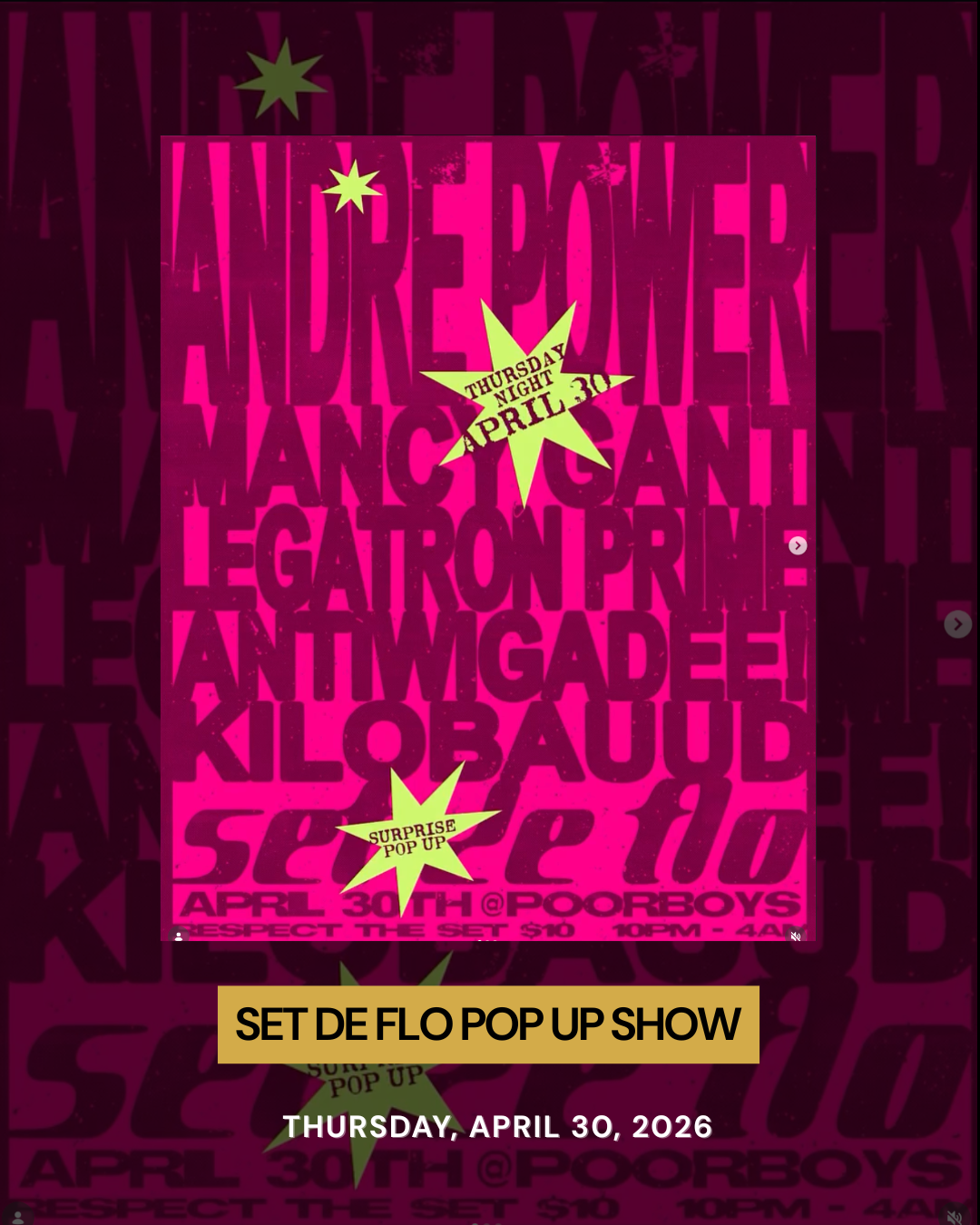
⚜️ Rooted in Southern club culture, KILOBAUUD’s latest project Yakamein reflects the energy, history, and people shaping the underground. ⚜️
New Orleans dance music has always lived in the underground first.
For KILOBAUUD, that is not just a starting point. It is the foundation.
After more than a decade of building spaces, pushing sound, and creating community across the city, his latest project Yakamein captures the raw energy of Southern club culture and the people behind it.
This is not about trends or surface-level moments. It is about where the music actually comes from.
We caught up with KILOBAUUD (@kilobauud) to talk about Yakamein, the South’s influence on dance music, and what it means to build something rooted in the underground.
NOLA EDM: For people discovering you for the first timel — who is Kilobauud? Tell us about your journey as a DJ and producer and how your sound has evolved over the years.
Tell us about your background, how this project evolved, and where your sound lives within heavier bass music.
KILOBAUUD: KILOBAUUD is really the umbrella over everything I’ve built in the New Orleans underground scene over the last fifteen years.
I started DJing under the name Cousin Cav, throwing day parties around the city. Eventually that evolved into Lil Jodeci, which is where I started building a bigger presence in the nightlife and music community.
Around 2015 I connected with Solange’s team and got involved with the Wine & Grind parties. I was actually the first DJ to throw a Wine & Grind event with Solange at her shop in New Orleans, and that moment ended up becoming a big part of the city’s nightlife around that time.
After that I co-founded the Pink Room Project, which helped push the underground dance scene forward locally. That eventually evolved into Set De Flo, which I’ve been running for about nine years now.
The way I explain it is KILOBAUUD is like Disney — it’s the parent company. All the different eras live under that umbrella. Lil Jodeci is Marvel. Cousin Cav is ESPN. All of those experiences built what KILOBAUUD is now.
At the core of it, my goal has always been to help build infrastructure for artists in New Orleans so our scene can grow on its own terms.
NOLA EDM: Your work has consistently centered the Black origins of dance music. Why is preserving and celebrating that lineage important in today’s club culture?
KILOBAUUD: A lot of club music has been separated from its Black origins over time. Part of my work is about preserving and celebrating the lineage that feeds into today’s club culture.
If we don’t do that, the history gets erased. It happens all the time.
I was actually talking with some friends in Houston about this last week during an interview we did on Ice House Radio about the Southern club scene and where things are heading right now.
When you look at genres like techno, house, Baltimore Club — all of these styles came from Black communities, but many of the artists who built those movements never received the credit or recognition they deserved.
So it’s important for us to be clear about where this music comes from. This is Black music. Black kids should feel comfortable participating in something their ancestors created.
We’ve seen the same pattern happen before with rock and roll and country music, where the origins get rewritten over time.
So preserving the legacy is important, but it’s also about ownership and intellectual property — because someone is always benefiting from this culture. The people who created it should be part of that story.
NOLA EDM: Through projects like Set De Flo and The Pink Room Project, you’ve helped shape spaces for house music and underground dance culture in New Orleans. What was the vision behind those projects?
KILOBAUUD: Pink Room Project started from the music itself. We were producing records and pushing a sound rooted in Black club music in the South.
A lot of what I was doing at Pink Room was playing records that I would play at home but wasn’t hearing outside in the nightlife scene. We combined that with underground rave culture and really pushed the energy as far as it could go.
Those events became pretty intense — we were building large productions, doing installations, having fire marshals show up at venues like the Ace because the parties were too packed.
Set De Flo came from recognizing a different need in the city. There wasn’t really a space where people could come together, feel sexy, dance, and hear house music presented from a Black perspective.
So both Pink Room Project and Set De Flo were really about building alternative third spaces in New Orleans nightlife — environments where people could connect through music and culture in a way that felt authentic
NOLA EDM: House music has always been about community and movement. What signals tell you the dance floor is truly locked in when you’re playing?
KILOBAUUD: For me it always comes back to community and movement, so there are a lot of small cues that tell you when the dance floor is truly locked in.
Sometimes it only takes one person. One person can be infectious enough to spark the energy for the entire room.
But the real moment is when the crowd starts moving in unison — when everyone is on the same wavelength.
That’s when the dance floor begins to feel like one organism instead of a group of individuals.
When I can feel that the room is in sync with me and I’m in sync with them, that’s when I know the set is really locked in.
NOLA EDM: You’ve spent more than a decade contributing to the city’s underground music culture. From your perspective, how has the New Orleans electronic scene evolved during that time?
KILOBAUUD: The scene has evolved tremendously.
When I first started playing dance/club music in New Orleans, the scene was pretty small. There were a few places like The Saint, where I was first introduced to playing dance music, but overall there weren’t many events centered around Black dance music that I was aware of at the time.
In response to that, I co-founded the Pink Room Project in 2015, which focused on pushing a new energy around club music in the city. A couple of years later I launched Set De Flo in 2017.
Interestingly, the collective Ascendance started the same weekend Set De Flo began, so for a while it was really just us as Black Collectives pushing that sound.
Around 2019 we began to see more activity in the scene, but after the pandemic the growth became much more noticeable. A lot more people became curious about underground dance music and club culture.
Now there’s a wave of incredibly talented DJs coming out of New Orleans, and the scene feels much more vibrant than it did when I first started.
NOLA EDM: Looking ahead through the rest of 2026, what releases, collaborations, or events should people keep an eye out for from Kilobauud?
KILOBAUUD: The next major release is my upcoming project Yakamein, which dropped at the end of the month (March) during the same weekend as Electronic Spring Festival.
Beyond that, I’m planning to release two or three additional projects this year through Set De Flo Records, including a compilation highlighting the city’s dance artists.
We’re continuing to expand the sound, collaborate with artists across the South, and take the Set De Flo movement to more cities.
But the immediate focus is Yakamein, which captures the raw club energy coming out of the South right now.
Follow Kilobauud
🌐 Artist Links:
📸 Instagram
🎧 YAKAMEIN
About NOLA EDM:
NOLA EDM is a New Orleans-based music and culture platform dedicated to documenting, promoting, and producing events that highlight the Gulf South’s electronic and underground scenes. Through artist interviews, editorial coverage, and festival production, NOLA EDM connects fans, promoters, and creators shaping the city’s next wave of sound. Follow NOLA EDM on Instagram for weekly event updates, giveaways, and exclusive artist features.
Subscribe now to keep reading and get access to the full archive.